

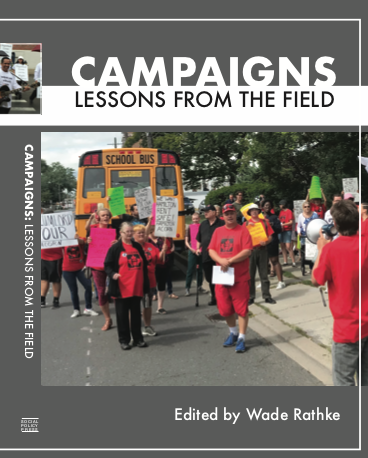



We’re all across the map this issue, so have your driver’s license and passport ready, because we’re rolling.
We jumpstart this ride with a call for the “next left” in the European Parliament (and beyond?) from David Tozzo in Rome, and then we jump to France with Marielle Benchehboune writing from Lyon to give us the real story behind the farmers’ protests that have created chaos in France. These are two veteran organizers who understand what’s under the hood.
We have a number of excepts on our next stops. Professors David Reynolds and Louise Simmons (also a longtime subscriber!) catch us up to date with regionalism, Partnership for Working Families style. Then we jump over to Vermont, and have a rare insider’s account by David Van Deusen of the politics and peril of moving a state labor council forward on issues of race in these times. He knows because he was the two-term president of the Vermont AFL-CIO. Felicia Kornbluh also has a Vermont connection in our small world as a professor
at the University of Vermont, but her insider’s account details what it took for New York State to be first out of the blocks with pro-choice legislation for women. The insiders in her story are her own mother and a neighbor. Then we go farther north to look at the issues faced by Toronto LBGTQ nonprofits written by a veteran of that landscape by Cameron Greensmith, now a professor of social work at Kennesaw State University outside of Atlanta. Our trip ends in Lowell, Massachusetts where community organizer Charles Gariuglo offers a memoir of growing up in a lower income neighborhood under the assault of urban renewal.
We take a rocket launch of sorts with our veteran reviewer and organizer, James Mumm, as he goes hard on fiction in a change of pace, much of which is other worldly. Next, we dial up the time machine to understand a priest’s fight against Cold War Anti-Communism in France with Toby Terrar, who has traveled widely himself, coast to coast, as a professor.
Back home our columnists bring us back to ground and current reality. Phil Mattera underscores the value of whistleblowers. Drummond Pike finds it mind blowing how some get away with money laundering and tax cheating. John Anderson doesn’t like his flashback over decades in Toronto’s fight for affordable housing for tenants. Gregory Squires makes it clear what’s really going on around bias in higher education. In Backstory, I take a more optimistic look at the prospects for labor’s revival.
I’m not saying that everything will be your cup of tea this issue, but I will say that none of this is boring!
Introducing the Regional Movement to Transform America
Years ago, when folk singer Odetta toured the United States she would pause the tempo of her concert, gaze out carefully into the audience, and explain “these are fearful yet exciting times!” A truer statement could not be said today. The fearful signs are obvious. The political right seems triumphant across the country both nationally and in state after state…However, there are signs for excitement. The ideas of a Green New Deal raised the call for a fundamentally more just and sustainable America. Starting with Occupy Wall Street, the last decade has seen the wide-ranging rise of protest movements from Black Lives Matter to #Me Too. Led by teacher walkouts, worker strikes appear to have made a comeback. In 2016, Vermont Senator Bernie Sanders demonstrated that progressive candidates can raise enough money through small grassroots donations to be competitive with corporate-backed candidates. The 2020 Democratic Presidential primary witnessed a clear battle between progressive and establishment candidates. And while a centrist secured the nomination and eventually the presidency, across the country progressives won seats stretching from Congress through state legislatures to city councils to local prosecutors…
Black Lives Matter. The Police and the Politics of Reality
Black Power is giving power to people who have not had power to determine their destiny. -- Huey P. Newton
Black Uprisings in the Wake of George Floyd’s Murder
The murder of George Floyd on May 25, 2020, at the hands of the Minneapolis police force sent shock waves of unrest across the United States. The racist killing sickened me, but in the days immediately following I did not anticipate that its impact would be felt across the continent. It was not until some days after his death that the political magnitude of what was about to unfold started to hit me.
Read more: EXCERPT - Insurgent Labor: The Vermont AFL-CIO 2017–2023
On Reproductive Rights and Justice, from Home to the World
The morning after the cerebral hemorrhage that would take my mother’s life, I was with my closest family members in our Saturday best, trying to compose ourselves as an audience for my nephew Eli’s bar mitzvah. My mind wandered to the scene in synagogue about thirteen hours earlier: Eli, insouciant in his suit, my sister Rebecca and me returning to our seats after lighting Sabbath candles — that pointedly female responsibility in Jewish practice that we did only awkwardly, mumbling the Hebrew prayer. My mother, Beatrice, leaned over to kiss my sister. Then she started to leave.
Read more: EXCERPT - The First Time as Tragedy, The Second as . . . History
How do queer organizations (for- and nonprofits who center their work around issues related to gender identity/expression and sexual orientation) in downtown Toronto work towards meaningfully addressing ongoing oppression experienced by Indigenous peoples? I have come to this project through a series of uncomfortable accidents. Before I “came out” in my early 20s, I had been exploring the ways that my own experiences and identities were informed by encounters with cisheterosexism. Focusing on how I felt and experienced oppression—as someone who identifies as mad, queer, and a cisgender-passing person and is interpolated as part of the lesbian, gay, bisexual, transgender, queer, and 2-Spirit (LGBTQ2S+) community—allowed for me to blissfully ignore the ways I benefited from interlocking systems of oppression.
[…]
Earlier this year, a federal judge in the District of Columbia ordered Gen Digital Inc. to pay $53 million in damages for cheating the federal government. The case against the company—formerly known as NortonLifeLock, a spinoff of Symantec Corp.—originated in a lawsuit filed by whistleblower Lori Morsell, who stood to receive a share of the payout. While working at Symantec more than a decade ago, Morsell discovered that the company was failing to provide federal agencies the discounts it made available to other customers.
Read more: EVERYBODY'S BUSINESS - Blowing the Whistle on Procurement Fraud
Other than almost getting killed three times, I had a pretty good summer. However, the wrist-and-arm injury would have a dramatic impact on life at home. I couldn't pick up my guitar, and the timing was terrible because I was more fired up than ever after we saw The Beatles in A Hard Day's Night at the Strand on Central Street. But that was nothing compared to Mom quitting her Hub Hosiery job, which had no health insurance, and getting back on welfare to cover me for the medical treatment I'd need for the rest of the year. She had to crawl back to creepy Mr. Lague, the social worker, and she knew that all the same jerks who put her down for being on welfare before were going to be talking behind her back all over again. And it also meant that she was going to have to go back to working under the table at that rotten barroom again so that we could have enough money to survive. All my stupid fault.
Read more: EXCERPT - Legends of Little Canada: Aunt Rose, Harvey's Bookland and My Captain Jack
As a public school kid, I’d just graduated from UC Santa Cruz, a brand spanking new campus that was perfectly timed for the late sixties. We had a ball exploring parent-free quasi-adulthood, protesting, experimenting, enjoying the early years of oral contraceptives, and on the side, learning. It was a rich time in every way but financial. (UC in those years was astonishingly cheap, by the way.) Graduating in 1970, I got my first “real job” working for the Center for Community Change in DC and moved in April with just an independent study project to finish. Two things impressed: heat and humidity. Oh, and the overwhelming sense that to do something in the political world, as well as to get on track to make a decent “professional” income in the future, becoming a lawyer was the ticket. With that in mind, I joined a volunteer group studying the broadcast industry under the banner of Nader’s Raiders, the moniker given to Ralph Nader’s legions of activist students and young lawyers seeking reform through the legal system.
An organizer trainee from the Netherlands was recently in the Toronto ACORN office. Their first training project was to organize an action at 500 Dawes Road, a privately owned rental building in East York, notorious for its negligent landlords. The action drew decent press coverage and a good turnout for a quick hit, with the emergence of a promising new ACORN leader in the building.
It felt like deja-vu all over again.
Read more: NORTHERN LIGHTS - For Many Toronto Tenants, Rent Increase Serves as an Eviction Notice
Just about every day some right-wing pundit or official is protesting the left-wing bias that they claim is dominating America’s colleges and universities. They are proposing wide-ranging policies to eradicate the “woke” culture presumably in control of the nation’s schools. This sentiment has emerged even among some academics themselves. One English professor recently wrote “Higher Ed, We Have a Problem. It’s time we start grappling with left-wing bias on campus and the problems that’s created for higher education.”
What a pleasure it is to be able to say, just maybe, I was wrong. The jury hasn’t finally come in, but I hope it finds me miles off base.
What am I talking about? Well, my last “backstory” expressed some fears and skepticism, as I rubbed the tea leaves, about whether unions were really back and on an upward trajectory. I hoped they were, but I wasn’t convinced that was really the case.
I’m still not, but over recent weeks there’s reason for more optimism than I was willing to express before. Maybe it has to do with spring? Maybe we can see light at the end of the tunnel? Who knows?
There’s good news for unions, and it’s worth celebrating forward movement.
Take Starbucks as a perfect example. Suddenly, there’s a major thawing. The company and the union have agreed on a path forward and are finally really negotiating. Back raises are being paid. Bargaining committees have been agreed. Internal reports that have filtered back to me indicate the real story is even better than the published reports. Union participants are hinting that this could be a total victory for the 350 stores and their workers around the country. That’s huge!
What worked? Was it the mass filing of more than 20 elections recently proving there was still gas in the tank? Was it the stockholders’ initiative put forward by the unions? Was it the preponderance of NLRB complaints on bargaining and firing? Likely all of these and just the steady struggle by the union and key workplace leaders to never stop fighting on all fronts. Fingers crossed for a contract that moves the needle for even more organizing.
Ok, Amazon is still a horror, but there was good news on that front as well. The NLRB issued a complaint around their union busting at the air depot and distribution center in Kentucky where there has been significant organizing. That’s a proof of life in the campaign once again.
Perhaps even more momentous, the UAW, coming off of their successful strike last year and their commitment to organizing the foreign car manufacturers or transplants, as they call them, is reporting real success. They have now filed for an election for over 4000 workers at the Volkswagen plant in Chattanooga. They’ve been there before, but they have filed with over 70% card strength, so this one could be a winner. That’s not all. They have dedicated $40 million to organizing and have also announced serious campaigns at Mercedes and Hyundai plants in Alabama. Am I just getting nostalgic? The UAW has been critical in the revival of the labor movement in the past. Could lightning be striking again?
I’ve still got my feet on the ground about all of this. I can’t keep from seeing the hard road ahead. Regardless, hoping and wishing isn’t a plan, but when there’s good news, let it shine. I don’t want to be a Debbie Downer. I want to be in the cheering squad.
Please, please let these be the sparks that light a prairie fire!