
Organizing Outside the Workplace: A Strategy for Labor’s Next Era
Written by SP Editor
On July 28, during the tumultuous year of 1968, Walter Reuther and the UAW established a rival labor federation to challenge the AFL-CIO. It was called the Alliance for Labor Action (ALA). Reuther’s vision for the new organization was based on the idea of a “community union.” Three months after its launch, Reuther was in a plane crash caused by a failed altimeter. He survived but died in another crash caused by a failed altimeter in 1970, and the ALA waned.
Unions organized under the National Labor Relations Act (NLRA) have been in decline for 50 years. For most of 2025, the National Labor Relations Board (NLRB) lacked a quorum on its national board; in effect, it was non-functional, as any appeal sat in limbo. In December, the Senate confirmed two Trump appointees to the Board. The main practical result is that the Board has resumed issuing decisions on requests for review of Regional Director decisions and on exceptions to Administrative Law Judge decisions. The new Republican-dominated Board is likely to begin revising Board law in a more management-friendly direction and probably will start reversing long-established precedents. The current Board lacks a three-member majority, the standing practice, to overrule the precedent. Explicitly noting their hesitation, the new Members agreed to continue this precedent while reserving their opinions on whether such remedies are permissible under the Act. The term of the sole Democratic Party nominee will expire in August 2026, allowing a new Trump appointee to constitute a three-member majority.
The Supreme Court will soon hear a challenge to the NLRA's enforceability. In one case, which grew out of unfair labor practice claims against SpaceX and two other companies, the U.S. Court of Appeals for the Fifth Circuit ruled in August that the NLRB structure was unconstitutional and granted the companies an immediate stay of the cases against them. This means that labor law is effectively unenforceable in Texas, Louisiana and Mississippi. The Supreme Court will hear this case in 2026. If the Fifth Circuit ruling is upheld, it could dramatically change how labor law is enforced in the U.S., because the NLRB enforces the NLRA— the core federal law protecting collective bargaining and union rights.
Does labor need to try something new?
In 1967, Walter wrote: “A new concept of union organization has been developing in areas such as Delano and Watts, California. Properly nurtured and motivated, it can spread across the face of the nation, changing the social character of the inner-city structure and uplifting the lives of millions of inner-city slum dwellers. This new organizing effort is called “community union.” It is designed to provide the poor with their own self-sufficient economic organization…. Community cuts across many areas of social and financial need…health care, schools, public transportation, sanitation, building maintenance, etc. These and many other facets of community life are integrated into the work and effort of “community unionism.”
WHAT WOULD A COMMUNITY UNION LOOK LIKE
In the summer of 1970, when the civil-rights movement was shifting into a new era and many urban neighborhoods were still reeling from postwar disinvestment, a small cluster of organizers in Little Rock began knocking on doors. Their goal was not yet clear to the world. But the project would become the Association of Community Organizations for Reform Now—ACORN—one of the most ambitious grassroots political projects of late-twentieth-century America. ACORN grew from a simple premise: poor and working-class people could wield political power if they built organizations rooted in their own neighborhoods, accountable to their own members, and unafraid to confront institutions that denied them access to housing, credit, and participation in public life.
ACORN’s methods were deceptively simple. Organizers walked block by block through the poorest parts of the city, listening to frustration about rent increases, rat infestations, broken police promises, and the sense—common in segregated neighborhoods—that public officials neither saw nor cared about the people living there. The technique echoed the methods used by the United Farm Workers, SNCC, and Saul Alinsky's community-organizing approaches. Still, ACORN’s voice was distinct: it insisted on organization not as a service provider but as an instrument of collective power.
From these early canvases grew a federated, membership-driven entity with chapters in more than seventy-five cities by the 1990s. ACORN’s identity crystallized around a cluster of interlocking concerns: housing rights, economic justice, community reinvestment, and electoral participation. In each, ACORN’s narrative was the same: entrenched systems—banks, landlords, municipal governments—had ignored working-class communities, and only organized pressure would force them to respond.
Housing and Community Reinvestment
ACORN’s housing campaigns began at a time when redlining was still a common practice. Residents told stories of banks refusing mortgages based on neighborhood racial composition, a system that effectively locked entire areas out of access to the credit needed to maintain property or purchase homes (Squires 1992, 103–115). ACORN canvassers gathered these stories into patterns, and then into reports. Those reports became the basis for direct confrontations with major banks, including what would become the famous “CRA agreements”—negotiated settlements in which banks agreed to expand lending in poor neighborhoods in exchange for reduced public conflict.
These agreements were sometimes worth billions in promised lending. For residents, they were among the first tangible signs that organized neighborhood campaigns could produce material change. The effort also placed ACORN squarely within the national debate around the Community Reinvestment Act (CRA). Over time, ACORN became one of the most prominent watchdogs on CRA enforcement, regularly filing complaints, testifying before Congress, and publicly shaming banks that resisted fair-lending commitments.
Economic Justice and the Living-Wage Movement
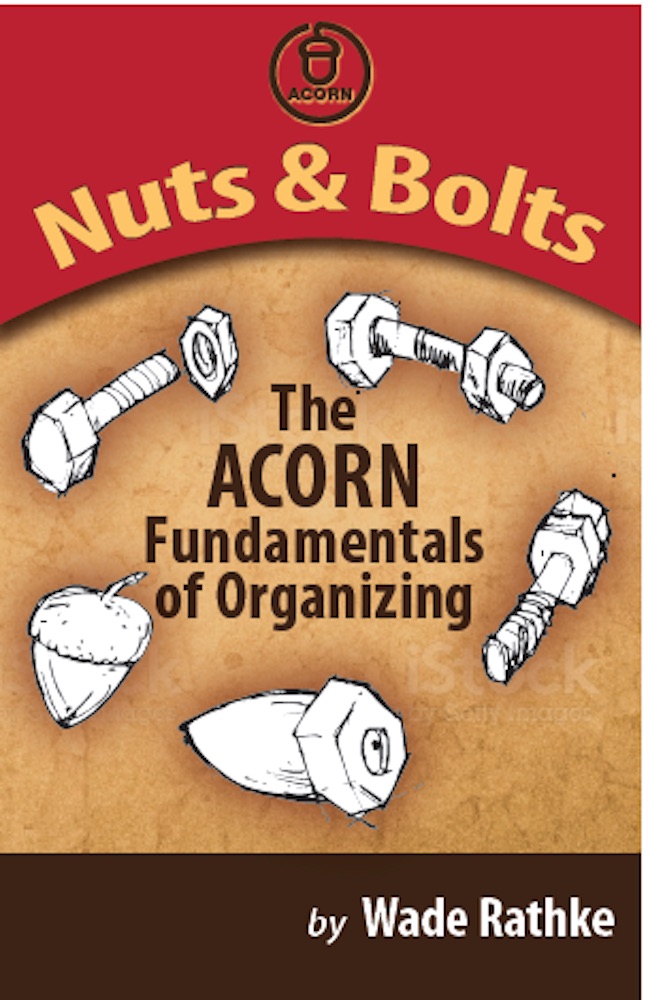
By the 1990s, as deindustrialization hollowed out many of the communities where ACORN worked, the organization increasingly turned to wage campaigns. It was an era defined by stagnant pay and rising costs of living; ACORN’s members—home-health aides, retail workers, janitors—were often stuck in the low-wage economy that had replaced factory work. Concerning efforts to support unionizing efforts, ACORN’s founder, Wade Rathke, wrote:
“We created unions as well, as you probably know. Most affiliated with SEIU around 1984, but were originally part of the United Labor Unions. In 2009, Local 100 went back with ULU. Our largest successes were pioneering the work of organizing home health care workers and home daycare workers, adding about 500,000 members to SEIU, 35,000 at one point to AFT, and 8,000 to CWA, through organizing contracts that employed our model with these informal workers who lacked a fixed workplace.”
ACORN embraced a simple but radical demand: cities should mandate that their contractors pay a “living wage,” defined locally according to cost of living. Baltimore passed the first such ordinance in 1994, and ACORN quickly helped export the model to cities across the country. These campaigns drew on careful research: ACORN would gather data showing that municipal budgets were subsidizing poverty-level wages, then stage rallies, hold accountability sessions with councilmembers, and flood hearings with workers who told their stories directly.
The living-wage movement later inspired the nationwide Fight for $15, though ACORN itself had dissolved by the time that campaign reached its peak. Still, many veterans of ACORN’s economic-justice fights played key roles in shaping that movement.
Voter Registration and Political Participation
ACORN also became a national force in voter-registration and turnout drives. Much of this work involved the same method that defined all its campaigns: door-to-door canvassing in low-income communities. ACORN viewed voter registration as both empowerment and strategy—a way to make political institutions more responsive to the very communities ACORN organized.
By the mid-2000s, ACORN was responsible for registering hundreds of thousands of new voters, particularly in African American and Latino neighborhoods. This work drew scrutiny. Conservative activists accused ACORN of orchestrating voter fraud, though investigations consistently found that cases of fraudulent registration were typically the result of individual canvassers submitting false cards—something ACORN itself routinely reported to election officials, as required by law. Still, the allegations stuck in the public imagination, and ACORN’s visibility made it an easy partisan target.
The Collapse
ACORN’s end came swiftly. In 2009, heavily edited undercover videos published online portrayed ACORN staff behaving improperly. Later investigations found that the videos were misleadingly edited and did not show illegal behavior, but the political damage was already done. Congress quickly voted to strip ACORN of federal funding, and many of its institutional partners withdrew under pressure. Without resources, the national organization dissolved in 2010.
Yet the dissolution was not the end of the story. Many state chapters reorganized under new names—Arkansas Community Organizations, New York Communities for Change, the Alliance of Californians for Community Empowerment—and continued local organizing. Others shifted into labor work or housing coalitions. ACORN’s DNA remained scattered across countless campaigns.
Perhaps most importantly, ACORN offered a model of democracy built from the bottom up: not as an abstract ideal, but as a practice forged in living rooms, porches, neighborhood meetings, and city council chambers. That vision—messy, confrontational, and deeply participatory—remains ACORN’s most enduring contribution.
Working America
Working America is a community-based organization founded by the AFL-CIO in 2003 to reach working-class people who were not members of labor unions. Working America became one of the most extensive membership-based political mobilization operations in U.S. history. It has a self-reported membership of five million. At a time when union density was declining, the federation sought a way to engage workers in nonunion workplaces on economic and political issues that affected their daily lives, such as wages, health care, retirement security, and job stability. Working America was designed as a membership organization, but unlike traditional unions it did not bargain contracts or represent workers on the job.
Instead, Working America functioned as a form of “community unionism.” It relied heavily on door-to-door canvassing, phone outreach, and later digital organizing to sign up members and mobilize them around policy campaigns. Members were sometimes encouraged to participate in issue advocacy, town halls, and grassroots lobbying, especially on legislation related to labor standards and social welfare. By framing its work around broadly shared economic concerns rather than workplace-specific demands, Working America aimed to build a broader working-class political constituency beyond organized labor’s shrinking base.
The primary focus of Working America’s activity was electoral politics. The organization became a key vehicle for labor-backed voter persuasion and turnout efforts, particularly in swing states. Because it organized nonunion workers as individual members rather than as a collective bargaining unit, Working America could engage large numbers of people who were otherwise outside the institutional reach of unions. This made it an important component of the AFL-CIO’s political strategy in the 2000s and 2010s.
Its goals limited its accomplishments. The creation of Working America was a way for the AFL-CIO to extend its political reach beyond traditional union membership, particularly before Citizens United removed restrictions on the use of union funds to reach non-union voters. The AFL-CIO-affiliated unions that fund the AFL-CIO are wedded to a business model that requires an NLRB bargaining unit contract with automatic dues check-off. This imperative prevented Working America from expanding into a genuine membership-driven, issue-oriented “community union.” It substituted electoral mobilization for workplace power and blurred the line between membership organization and political campaign apparatus.
Working America, an AFL-CIO–affiliated organizing initiative, and ACORN, the grassroots community organization, emerged in different eras and with differing institutional structures, but they share a remarkably similar core: both were mass-membership efforts built to organize people outside traditional union or civic frameworks—particularly working-class, lower-income, and politically marginalized communities. Each organization sought to create a political voice for people who typically had none, using intensive field work to build durable membership lists, mobilize voters, and influence local and national politics.
Both groups are best understood as large-scale experiments in organizing the unorganized. ACORN focused on low-income neighborhoods—often urban, multiracial, and tenant-dense—while Working America targeted the millions of non-union workers who lived in predominantly working-class communities, including suburbs and smaller metros. Despite these contextual differences, both organizations addressed the same central problem: that the American working class lacked institutions capable of consistently defending its economic and political interests.
The two groups shared a commitment to door-to-door organizing on a massive scale. For ACORN, the doorstep was the heart of its model: organizers developed neighborhood chapters, recruited dues-paying members, and built local campaigns around housing, wages, utilities, and community safety. Working America did something structurally similar, though without ACORN’s member-led chapters. Canvassers knocked on doors, identified persuadable workers, and signed them up as members—creating a political identity for workers who had no union affiliation but often shared union-aligned economic values. Both organizations viewed face-to-face contact not as a supplement to organizing, but as the organizing itself.
They also converged around a shared theory of political transformation: that policy change comes from building large, politically active constituencies, not simply from lobbying or election spending. ACORN pursued this through direct action campaigns and local political pressure; Working America did it primarily through electoral mobilization and issue persuasion. In effect, ACORN tried to build community power from the bottom up, while Working America focused on shaping working-class political behavior at scale. The mechanisms differed, but the aim—shifting political outcomes by mobilizing people excluded from other institutions—was common.
Another major similarity is that both organizations often operated in terrain where unions and mainstream liberal organizations had little presence. ACORN inhabited neighborhoods long abandoned by traditional civic groups. It filled an institutional gap: ACORN became one of the largest anti-poverty organizations in the country. At the same time, Working America specialized in canvassing white, Black, and Latino working-class communities in swing states—places where unions usually had no members.
They also experienced parallel challenges. Both were criticized—sometimes fairly, often politically—because their large-scale ground operations made them highly visible targets. ACORN faced attacks that eventually destroyed the national organization; Working America has avoided that fate but still faces scrutiny for its canvassing methods and political role. Each proved that building mass membership structures for working-class people is possible, but also politically fragile.
Ultimately, what ACORN and Working America share is a strategic commitment to organizing people who lack stable institutions, a reliance on human-to-human contact, and a belief that broad working-class mobilization is essential for meaningful political change. While their structures differ—ACORN as a community organization, Working America as a federation project—both stand out as ambitious attempts to reconstruct a democratic, participatory base for American workers.
Taken together, ACORN and Working America show that Reuther’s concept of “community unionism” was not an abstract ideal but a workable strategy that has already reshaped parts of American political life. Each demonstrated that durable power can be built when working-class people—whether tenants in disinvested neighborhoods or non-union workers in sprawling metros—are organized through face-to-face relationships and connected to campaigns that improve their material conditions. They also revealed the vulnerabilities of such efforts in a political environment hostile to mass participation. Yet the lessons remain clear: when traditional labor law falters and the NLRA’s institutions erode, broad-based organizing rooted in communities, rather than workplaces alone, offers labor one of its few remaining paths to scale. Reuther’s call for a “community union” was ahead of its time; the experiences of ACORN and Working America suggest it may now be the most relevant blueprint for rebuilding democratic power among America’s workers.
McKenzie, now retired, was President of UAW 879 at the Twin Cities Ford plant from 1998 to 2006. When Ford announced their decision to close the Twin Cities Plant in 2006, and later on the International UAW staff as a regional
servicing representative working in Minnesota, Wisconsin, and Iowa. He was on the Minnesota State AFL-CIO Executive Board for twelve years and was elected secretary-treasurer of UAW Ford Sub-Council #2, a national bargaining
council comprising U.S. Ford assembly plants, from 2002 to 2006.