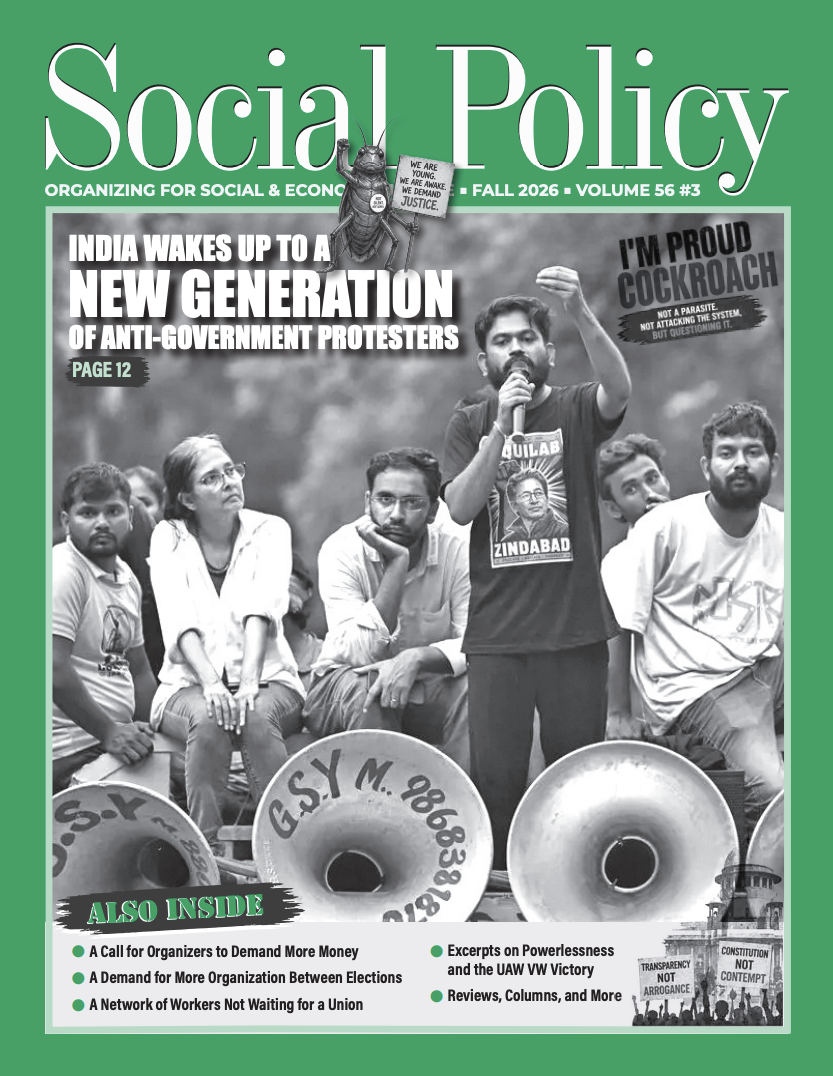



If there was ever an “American Century,” this isn’t it! In Trump 2.0, we literally have front row seats every morning when we open the papers or our computers to watch the diminishing of a great country, flaws and all, in real time. All of us living in the United States and around the world now stand witness to a country shedding any semblance on its 250th anniversary of a unique commitment to democracy, its institutions, and its people. Trump’s commitment to making America greedy again seems unbridled. What was hidden in the past is now on full daily display without any pretenses.
That doesn’t mean that the rearguard isn’t fully engaged, as readers can find in this issue. Randy Shaw, activist, organizer, lawyer, and author begins this issue with a demand for donors and foundations to support organizational capacity building to make the change and makes a call to action for others to join with him. Chris Williams, a veteran political organizer, echoes that call with a critique that underscores Shaw by arguing that we get what they pay for, which is a cyclical political season, when we need organization for change every day and year-round.
India in twelve years under Prime Minister Modi has a lead on the United States and Trump’s in the race to autocracy. Vinod Shetty, a labor advocate, and director of the ACORN India Foundation in Mumbai, reports that for all of the scoffing about GenZ, in India the Cockroach Janta Party has creatively brought the government to its knees in a movement that has forced the resignation of the education minister and is pushing for reforms in the entire educational raj. As Tyler Daguerre might argue, maybe that’s because independence works, at least from his experience with labor unions being built by a similar grassroots rank-and-file.
Yotam Marom might have a lot of say about this phenomenon as a new generation of organizers and activists comes center stage. As a veteran of Occupy Wall Street and many other contemporary campaigns, his excerpt recommends that we break past our politics of powerlessness to make change. Professor Abe Walker’s excerpt, excavates how the UAW won in VW’s Chattanooga auto plant after two earlier losses, makes the case for leadership change driven by the rank-and-file and new modes of organizing that at least for a minute seemed to have promise.
James Mumm is back with a great review of Beryl Satter’s new history of the fight against redlining that is also deeply entwined with his own experience as an organizer. Mike Miller has mixed feelings about Beth Roy’s book, Reclaiming Humanity, and its sweeping agreement for change, applauding the eagle’s view, as he maintains the value of the worm’s.
Our columnists, as usual, pull no punches. Phil Mattera applauds the value of campaigns in winning corporate accountability. Drummond Pike joins all of us in disbelief and horror at the amount of money being poured into political campaigns to dwarf our own voices. John Anderson shares some interesting points and concerns about the Trump-effect in Canada and how it is empowering corporatist liberalism under business-oriented Mark Carney as prime minister. Inequality is threatening democracy, and Gregory Squires offers the details on who and why that’s happening. In Backstory, I continue to beat the drum about the accelerating horrors of Trump and the Republicans war against the poor.
We’re not giving up without a fight!
Social Policy readers know the value of community organizing. We recognize:
*most politicians need grassroots pressure to do the right thing;
*organizing builds political relationships;
*organizing expands a campaign’s political base; and
*grassroots organizing is the most effective strategy to defeat Big Money and powerful interests.
Despite the demonstrated success, foundations and large donors have slashed funding for community organizing over the past two decades. The “progressive” foundations that defunded ACORN in 2009 did not shift their money to other grassroots organizing groups. Instead, a vast level of progressive resources now goes to election campaigns. Wealthy progressives continue to donate staggering sums to elections while shortchanging the ongoing community organizing that builds the political base necessary to win.
Read more: Can We Reverse the Decline in Community Organizing?
ACORN India
Public space for dissent has been shrinking steadily in India over the last 12 years. Students, workers, farmers, tribals, and journalists have increasingly faced repression for any action questioning the government of the right-wing nationalist Bharati Janata Party (BJP). Demonstrators have faced batons, water cannons and even pellet guns that have resulted in serious injuries. They have been charged under draconian laws such as the Unlawful Activities Prevention Act, and held without bail for years on end, as the judicial system is sympathetic to the party in power. “Unfortunately, even normal activities are being criminalized,” declared a sitting judge of the Supreme Court of India. Justice Ujjal Bhuyan was delivering the fourth Justice G P Singh Memorial Lecture at the National Law Institute University, to an audience of budding lawyers and jurists.
In this scenario, none of the political pundits imagined that an online satirical movement would grow into a serious political challenge to the Modi government which has systematically destroyed much of its opposition in Parliament.
The origins of the CJP can be traced to mid-May 2026, provoked by the Chief Justice’s caustic reference to unemployed youth as "cockroaches." While the Chief Justice later claimed that his comments were taken out of context, the term sparked widespread outrage online. The internet where most young people seem to live was on fire, prompting a young Indian student in a US university to do the Gen Z thing: launch a digital campaign. Abhijeet Dipke set up a satirical account in the name of the Cockroach Janta Party – which got 15 million Instagram followers in one week.
The Independent Organizing Network (ION) started off as a one-off idea to support a local union effort, but it has become part of something much bigger. Since forming ION, we’ve watched independent unionism turn into something other than just a one-off success story. We are now witnessing the profound rise of an independent union movement and, alongside it, inspiring levels of worker participation, empowerment, and democracy. The organizing work happening in the independent union movement proves what many have felt and known all along: that workers are done relying on overly legalistic and bureaucratic “business” unionism; and they are, in fact, willing and able to take matters into their own hands as rank-and-file worker-organizers and fully operate their own unions. ION exists to help workers fully realize their potential without having to endure the Faustian bargain of paying legal fees or sacrificing their autonomy for access to vital resources.
Although ION officially formed in October of 2023, its true origins began in late 2021, when I first experienced being part of a rank-and-file movement. That year, my coworkers and I decided to unionize our Starbucks store in Boston. We joined the Starbucks Workers United (SBWU) movement early into the campaign and, since there were no Workers United staff organizers in the state at that time, we took on much of the day-to-day organizing. We weren’t technically an independent union, but we operated like one: For the first six months of the Boston SBWU campaign, workers led store and regional level meetings, held frequent inoculation trainings, and prepared for pre-election hearing proceedings. The rank-and-file took the lead.
Read more: Independent Organizing Network: It Just Got Easier for Workers to Form their Own Unions
What Is the Path to Change? A review of Reclaiming Humanity by Beth Roy.
Introduction
In this rapid-fire discussion of gender, status and class; psychiatry and conflict resolution; identity, compromise and radical change, Beth Roy addresses the major issues and problems of our time. A professional mediator, she knows conflict in the intimacy of resolving it between individuals and within organizations.
As a Marxist, she centers her analysis in class. But this is no simple economic determinism. She places patriarchy as its carrier in practice. She gives careful attention to race and gender.
Roy deals with the threat of climate change, and still believes in the possibility of a better future. She offers thoughtful ideas to those who struggle with damaging internal conflict in organizations that seek to change the world. She has specific ideas on how to deal with them, and practices that can implement those ideas.
At the end, I came away with important reservations about her outlook, one having to do with power and organization, the other with an analysis that makes class and patriarchy the central concepts to understand where we are and guide us forward.
I enjoyed and learned from the reading. You can’t ask for much more in 200 pages.
Who Gets What and Why and How Surging Inequality Threatens Democracy
Income and wealth inequality seem almost as certain as death and taxes, at least since the 1970s. Persisting patterns of such inequality convey a sense that this is just the natural order of things. For those who came of age during these years, it is difficult to blame them. But there is nothing natural about this order. It has evolved in response to a series of specific public policy decisions and private industry practices. But that which was created by such decision-making can be undone by other approaches. And we are beginning to see what some of those might be.
The study of inequality has long been at the core of the social sciences in the U.S. In his 1966 book Power & Privilege, American sociologist Gerhard Lenski succinctly defined what he referred to as social stratification as the phenomenon of who gets what and why. Unfortunately, American culture has ignored what Lenski wrote about power and has long exhibited an individualistic bias in its understanding of such inequality. Those who get ahead, we are told, worked hard, learned how to defer gratification and developed appropriate entrepreneurial skills and related human capital. Those who fell behind lacked these qualities. But as another American sociologist, C. Wright Mills, famously taught us in his 1959 book The Sociological Imagination, context matters.
Read more: COMMUNITY DEVELOPMENT CORNER - It’s the Inequality Stupid
Backstory – BRAVO!
Trump’s Budget Bill Meet ACORN’s BRAVO
Sixty years ago, the National Welfare Rights Organization (NWRO) was founded in June 1966 when Dr. George A. Wiley mobilized small groups of welfare mothers and supporters to a march in Columbus, Ohio to protest cuts in welfare payments. It almost seems quaint to write those words now, decades later, because cuts in welfare payments are now national and commonplace. But, three years later, not long after being at a three-year anniversary of the organization at a rally on the Boston Commons where Wiley spoke along with Dr. Benjamin Spock, I was recruited that summer to expand the operations of the Massachusetts Welfare Rights Organization into Springfield. NWRO was the largest organization of poor people in the United States. They were militant, effective, and winning. I grabbed the chance to help them organize.
Now with Trump’s bad budget bill the war on the poor has, yet again, ratcheted up to a whole new level. New bureaucratic procedures and recertification “paper cuts” coupled with expanded and onerous work requirements of 80-hours per month for lower income, working families and recipients are the tradeoffs for continued and expanding perks for the rich. More than 5 million SNAP food stamp recipients have already been pushed off the rolls at such a devastating pace that the Congressional Budget Office hadn’t expected the bill would produce until 2030. In January, the budget rules mandate procedures that are expected to reduce the Medicaid rolls by 14 million recipients.
NWRO met the challenge in Ohio and many other states in its brief history. The challenge to Trump’s budget bill has to be met now as well. ACORN is seeking to respond by launching a new affiliate, BRAVO – Benefit Recipients Access and Volunteer Organization. BRAVO/ACORN has organizers on the ground now in Little Rock and Philadelphia and by the time you read “Backstory” will also be in Cleveland, Baltimore, New Orleans, Houston, and maybe other cities as well.
Read more: BACKSTORY 56.3 Trump’s Budget Bill Meet ACORN’s BRAVO